
Custom Commemorative Coins: Materials, Finishes, Shapes, Edges and Packaging Explained
Planning a custom coin involves more than placing a logo on metal. The material, relief, plating, color, edge and presentation all affect the result—and the budget.
- Zinc Alloy
- Brass
- 999 Copper
- 999 Silver
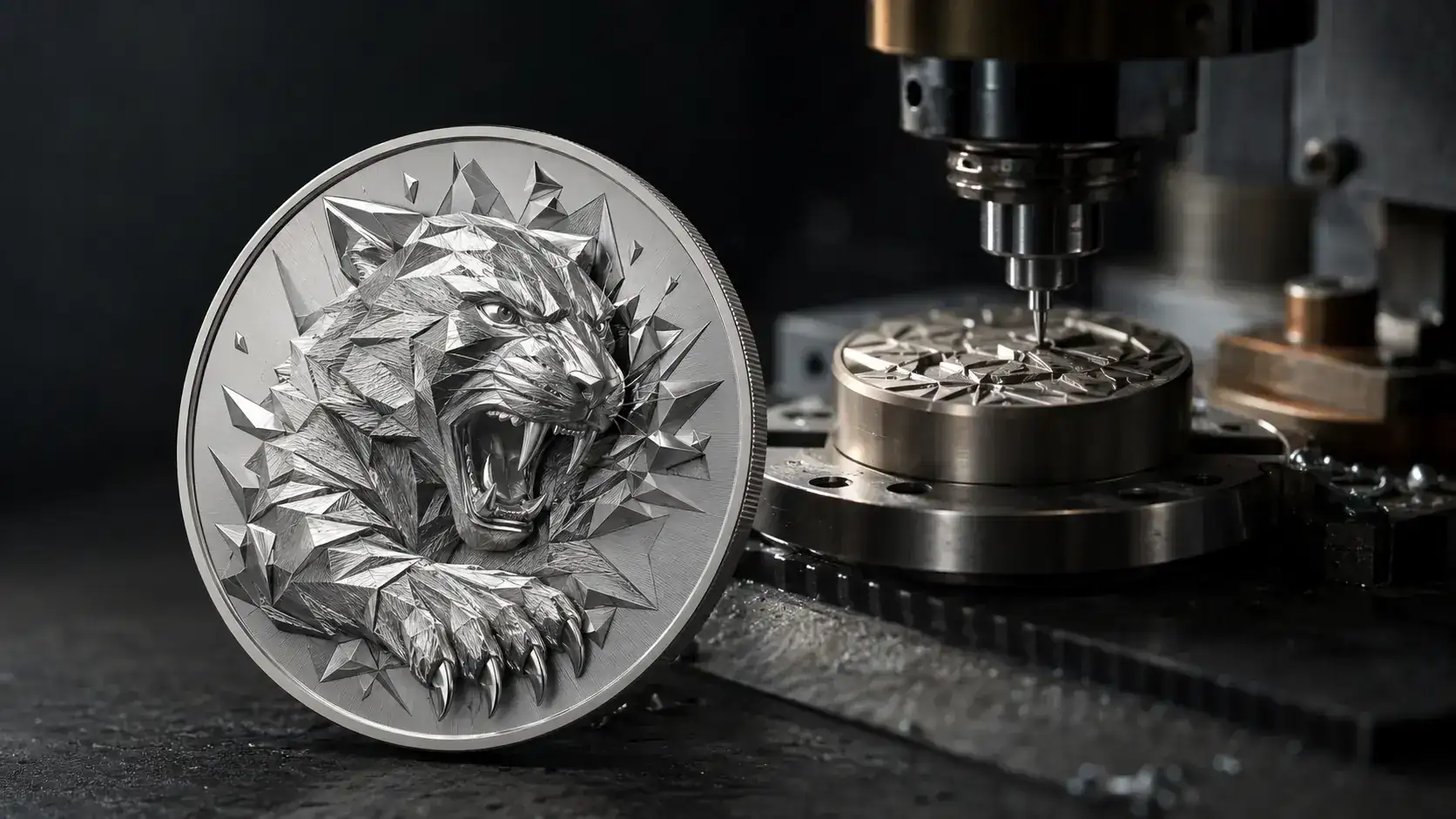
The best specification is not automatically the most expensive one. It is the combination that expresses the idea clearly, performs well in production and leaves enough budget for the details your recipient will notice.
Q1. Which material should I choose for a custom commemorative coin?
Choose the material around the design, quantity and purpose.
Start with the intended use, required shape and relief, then compare quotations with the same size, thickness, quantity and finish.
| Material | Best suited to | Shape and relief | Budget considerations |
|---|---|---|---|
| Zinc alloy | Custom shapes, larger formats and deep-relief designs. | Flexible for complex sculpted designs; relief up to 7 mm (0.28 inch), subject to design review. | Compare size, thickness and relief height when setting the budget. |
| 999 Copper | Traditional commemorative coins with a substantial feel and fine detail. | Pure copper supports relief up to 3 mm (0.12 inch), subject to design review. | Compare thickness, weight and surface finish in the quotation. |
| Brass | Classic coins with a warm golden base tone and substantial feel. | Brass and bronze are different materials. Brass relief feasibility needs a design review. | Compare the same size, thickness and finish with copper. |
| Stainless steel | Flatter, modern designs where durability and corrosion resistance matter. | Its hardness can limit very deep relief; confirm the design and production method. | Request a design-specific quote rather than assuming it is the lowest-cost option. |
| 999 Silver | Limited editions and formal gifts where precious-metal value matters. | Confirm silver weight, size, thickness and the desired relief together. | Silver prices fluctuate daily; request a current quote. |
| Titanium alloy | Custom commemorative coins and distinctive presentation pieces. | Confirm the alloy grade, relief and production method for the specific design. | Request a design-specific quotation for material, machining and finish. |
The base metal does not determine the final colour: plating, enamel, printing and antique finishes also affect appearance. Relief height is separate from total coin thickness. Final feasibility and pricing depend on the approved design.
Zinc alloy
Suitable for: Custom shapes, larger formats and deep-relief designs.
Design considerations: Flexible for complex sculpted designs; relief up to 7 mm (0.28 inch), subject to design review.
Budget: Compare size, thickness and relief height when setting the budget.
For your quote: Send the outline, size, thickness and desired relief height.
999 Copper
Suitable for: Traditional commemorative coins with a substantial feel and fine detail.
Design considerations: Pure copper supports relief up to 3 mm (0.12 inch), subject to design review.
Budget: Compare thickness, weight and surface finish in the quotation.
For your quote: Confirm thickness, relief height and the final surface finish.
Brass
Suitable for: Classic coins with a warm golden base tone and substantial feel.
Design considerations: Brass and bronze are different materials. Brass relief feasibility needs a design review.
Budget: Compare the same size, thickness and finish with copper.
For your quote: Specify brass; confirm relief feasibility and plating or antique finish.
Stainless steel
Suitable for: Flatter, modern designs where durability and corrosion resistance matter.
Design considerations: Its hardness can limit very deep relief; confirm the design and production method.
Budget: Request a design-specific quote rather than assuming it is the lowest-cost option.
For your quote: Send artwork and confirm the required relief, printing or engraving.
999 Silver
Suitable for: Limited editions and formal gifts where precious-metal value matters.
Design considerations: Confirm silver weight, size, thickness and the desired relief together.
Budget: Silver prices fluctuate daily; request a current quote.
For your quote: Confirm weight, quantity, finish and presentation packaging.
Titanium alloy
Suitable for: Custom commemorative coins and distinctive presentation pieces.
Design considerations: Confirm the alloy grade, relief and production method for the specific design.
Budget: Request a design-specific quotation for material, machining and finish.
For your quote: Specify the alloy grade, size, thickness, artwork and desired finish.
View material examples on the product page →
For a comparable quote, provide the material, dimensions, thickness, quantity, artwork, finish and packaging requirements. Review the Buyer FAQ for pricing and order details.
Q2. What plating and surface finishes are available?
Plating sets the overall tone; texture and color create the contrast.
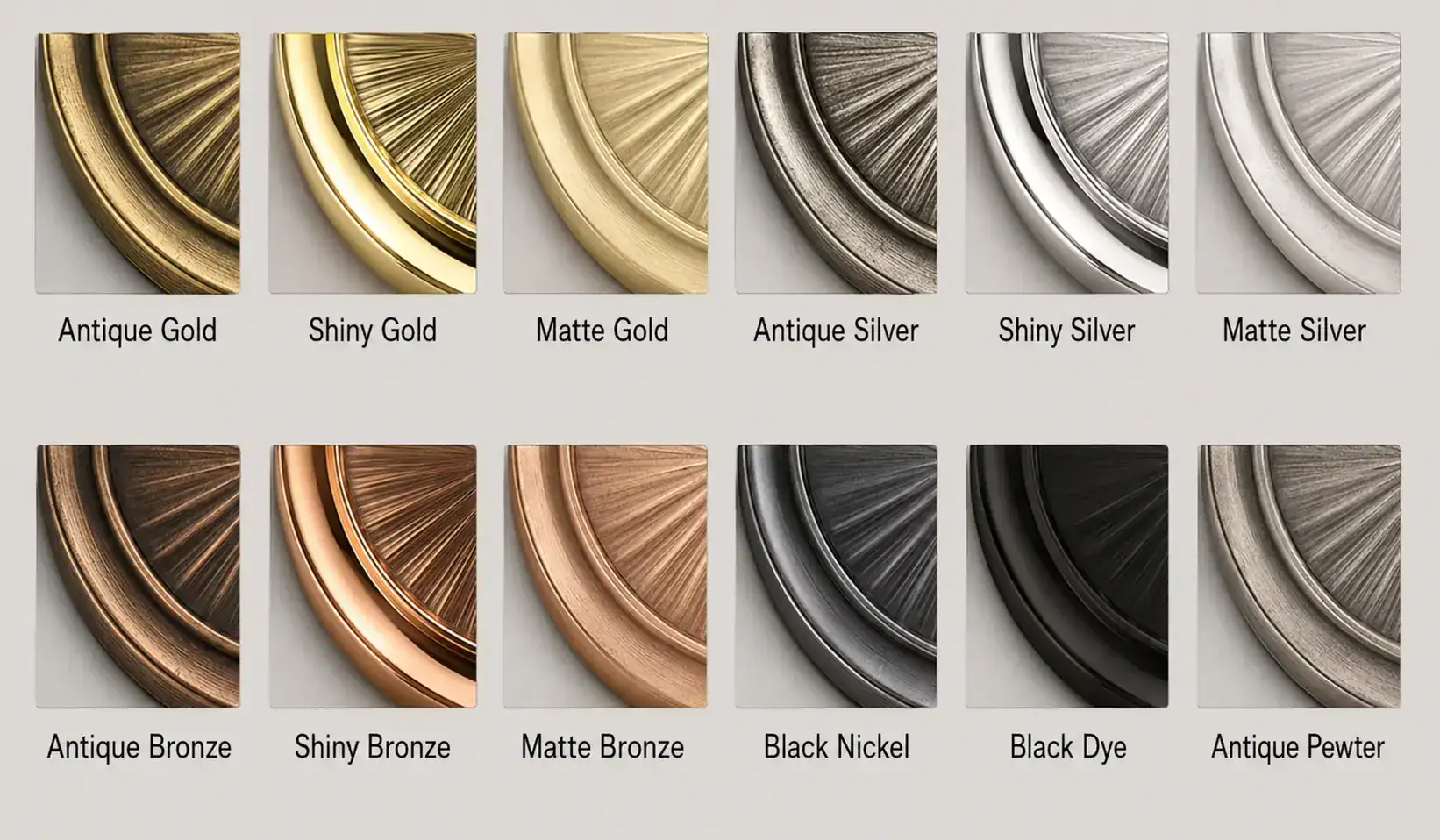
Common options include shiny, matte and antique gold or silver, bronze finishes, black nickel, black dye and pewter-style finishes. For suitable 999 Copper or 999 Silver projects, selective real-gold plating is reviewed against the required composition, coverage, thickness and supporting documentation.
Q3. Should I use UV printing or enamel color?
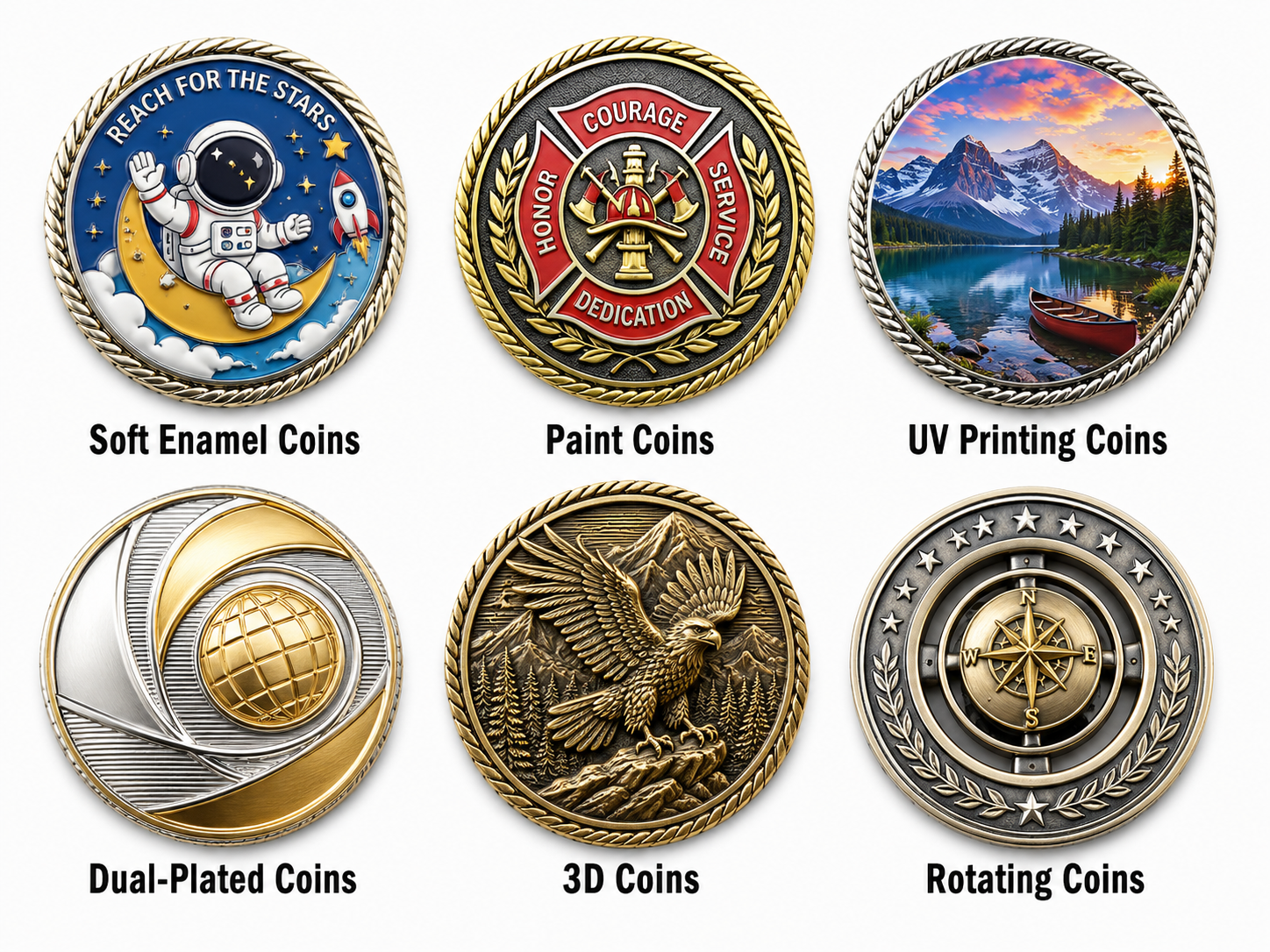
Use UV for printed detail and gradients; use enamel for a classic filled-color look.
UV printing supports gradients, fine patterns and photographic elements. Enamel color is filled into recessed metal areas and cured, creating a traditional tactile appearance.
Q4. Does a commemorative coin have to be round?
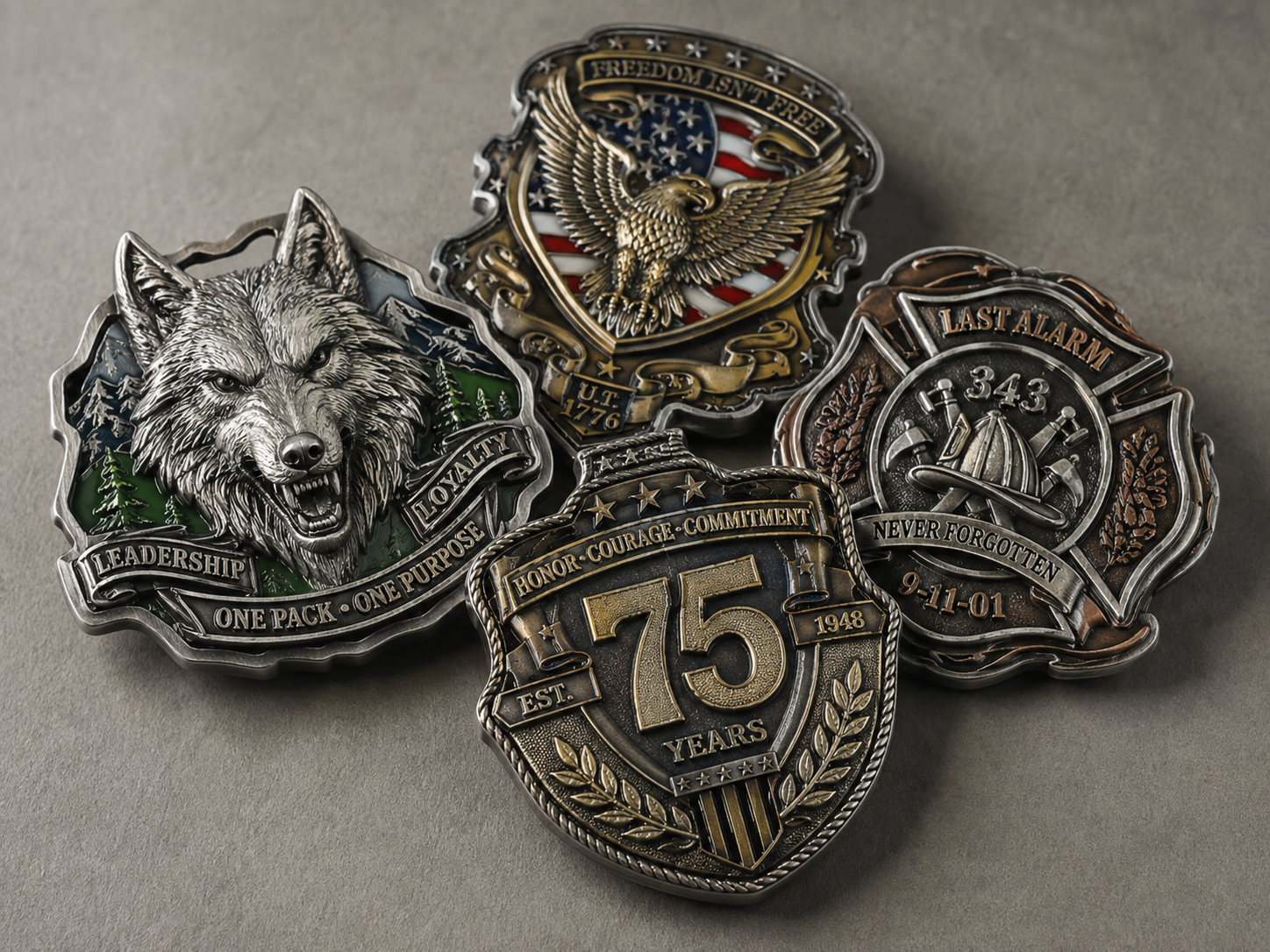
No. Round is classic, but the outline can follow the story.
Round coins are efficient to manufacture, easy to package and suited to border text. Custom outlines can follow a shield, emblem, building, character, map or symbolic object. Sharp projections and narrow sections may need to be softened for safe handling and reliable production.
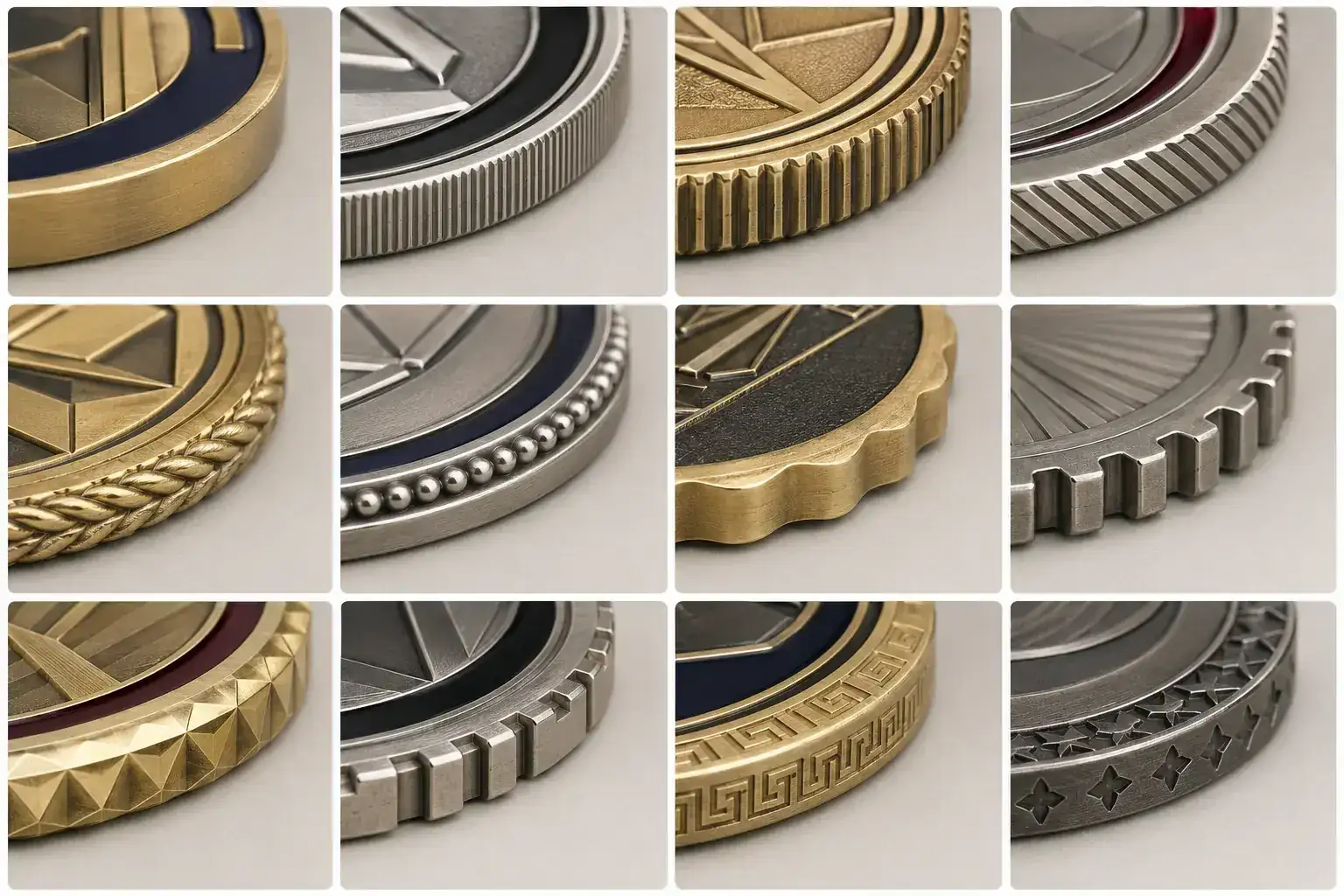
Q5. What edge styles can be added?
The edge is a small surface with a surprisingly large impact.
Options include plain, reeded, diagonal reeding, rope, diamond-cut, gear-style and interrupted-groove edges, plus raised or recessed edge lettering. The right option depends on thickness, diameter, plating and the face design.
Q6. Which packaging is suitable?
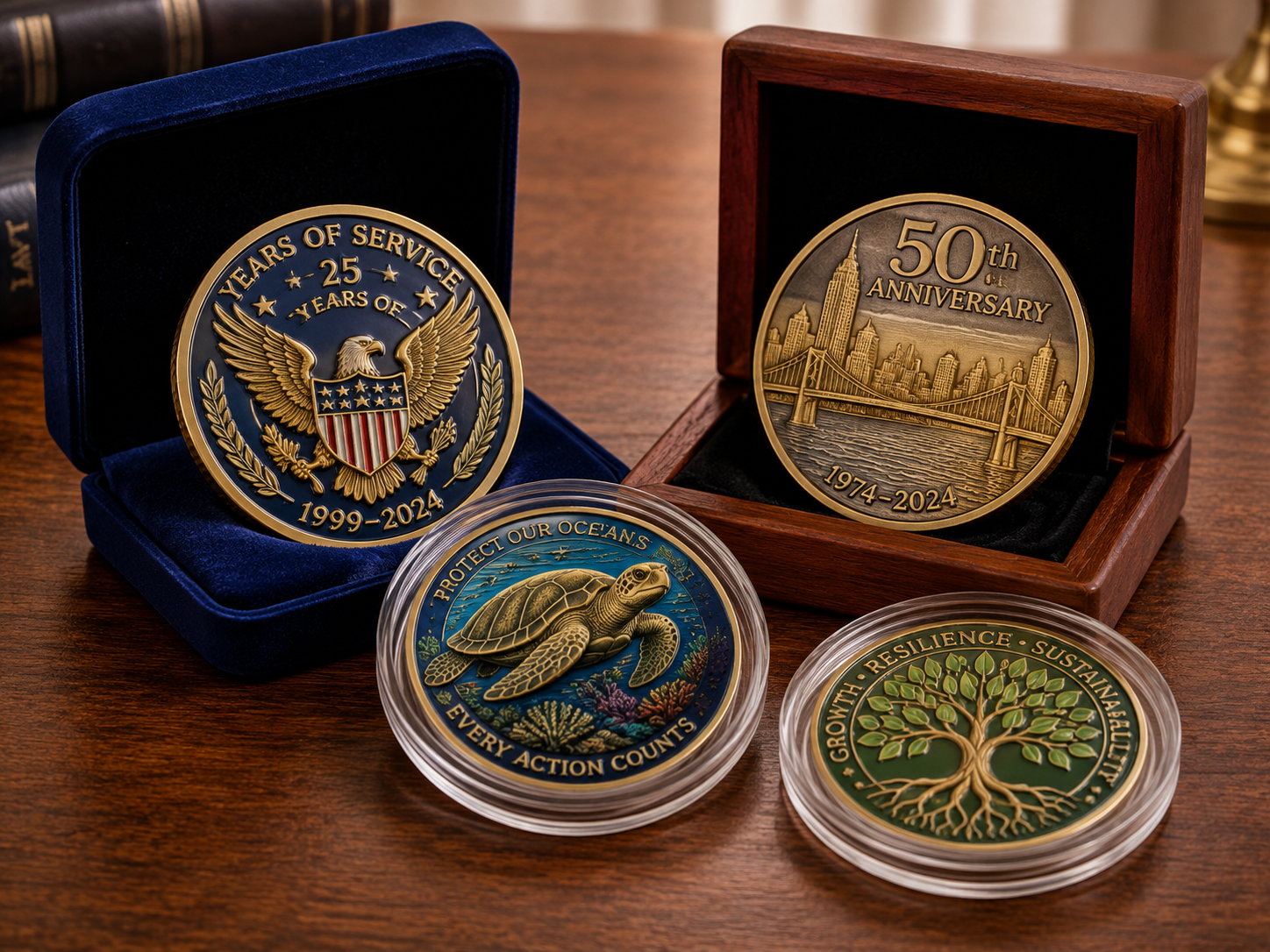
Match the packaging to the presentation and distribution plan.
The default packaging is an OPP bag. Packaging and charges follow the quotation. A clear acrylic capsule protects the surface while keeping the coin visible. A velvet box provides formal individual presentation. A wooden box creates a substantial collector experience for one coin or a set. Packaging also affects freight volume, protection and delivered cost.
Q7. How can I stay within budget without making the coin look cheap?
Protect the details that carry the idea, and simplify the rest.
Compare diameter, thickness, material, relief, plating, colors, edge treatment and packaging. A strong zinc-alloy coin with thoughtful relief and antique plating may communicate more value than an expensive material paired with weak artwork.
Q8. What should be checked before mass production?
Approve the production logic—not only the screen artwork.
Check spelling, dates, logo clearance, relief hierarchy, minimum line widths, color separations, edge choice, dimensions and packaging fit. Approve a physical or documented pre-production sample whenever timing allows, then inspect plating, color, surface quality, packaging and quantity against it.
Challenge coin design questions answered
What is a custom challenge coin?
A custom challenge coin is a small, specially designed token used to recognise service, mark membership or commemorate a shared achievement. It commonly carries an organisation’s emblem, message or event details. C-Creation develops challenge and commemorative coins around your artwork, preferred materials and presentation needs.
How is a challenge coin different from a commemorative coin, medal or badge?
A challenge coin usually emphasises recognition or membership, while a commemorative coin highlights a person, event or anniversary; their designs can overlap. Medals are often presented as awards and may use ribbons. Badges and pins are commonly attached to clothing. Choose the format around how the recipient will carry, wear or display it.
Why are they called challenge coins?
The name is associated with traditions in which members challenge one another to show their coin. Challenge coins are also exchanged to recognise service, belonging and achievement. Customs vary between groups, and accounts of their origins differ. You do not need to follow a particular coin-challenge tradition to create a meaningful recognition coin.
What is the difference between soft enamel and hard enamel challenge coins?
Soft enamel leaves the colour below raised metal lines, creating a textured surface. Hard enamel is finished closer to the metal level for a smoother appearance. The better choice depends on artwork, finish compatibility and the result you want, rather than one process being universally better. Ask C-Creation to compare both routes for your design.
What is the difference between 2D relief, 3D relief and cut-out coin designs?
2D relief uses distinct raised and recessed levels. 3D relief uses sculpted contours to create depth and curved forms. A cut-out removes metal to create an opening through the coin. These features can sometimes be combined, but their suitability depends on material, thickness, small details and structural strength. We review the combination before quotation.
Can small text and complex artwork be reproduced clearly on a coin?
Often, but the artwork must be assessed at the finished coin size. Small lettering, narrow gaps and fine metal lines may need enlarging or simplifying. Printed detail may suit some images better than filled enamel. Send the original artwork and target dimensions so C-Creation can review legibility; critical details should be checked on the agreed proof or physical sample.
How do zinc alloy, brass, 999 Copper and 999 Silver challenge coins compare?
Zinc alloy is useful for complex cast shapes and deep relief. Brass and 999 Copper can provide a substantial feel and suit traditional struck detail. 999 Silver has a precious-metal cost basis and should be specified by weight as well as dimensions. Compare the artwork, construction, finish and budget together. C-Creation can provide material samples for purity testing at your request.
Can selected areas of a silver coin be plated with real gold?
Selective real-gold plating can be reviewed for your 999 Silver or suitable copper coin project. Send the areas you want plated and the required base material. Gold-coloured plating is not automatically a specified real-gold coating. The coating composition, coverage, thickness and any required supporting documentation must be confirmed for the quotation.
How is the price of a 999 Silver challenge coin calculated?
A 999 Silver coin quote depends on the metal weight, daily silver quotation, tooling, manufacturing, finishes and quantity. Precious-metal prices fluctuate, so use the quotation issued for that day rather than an older reference price. Mould fees, packaging and shipping are separate from the reference unit price; the project quotation confirms the applicable charges.
Tell us what the coin needs to represent.
Share the idea, size, quantity, deadline, destination and budget level. We will help turn them into a practical specification.
Turn These Choices Into Your Coin Brief →